
 admin

“HOW IS THIS NOT A RED CARD?” — MIKE DEAN SLAMS PGMOL AFTER NOTTINGHAM FOREST ARE LEFT FUMING OVER ISSA DIOP’S CHALLENGE ON JAMES MCATEE
Mike Dean has questioned a controversial refereeing decision involving Nottingham Forest and Ipswich Town after Issa Diop escaped a red card for his challenge on James McAtee at Portman Road.
A major refereeing controversy has erupted following a contentious moment in Nottingham Forest’s clash with Ipswich Town, with former Premier League referee Mike Dean questioning why Issa Diop was shown only a yellow card after bringing down James McAtee in a situation that immediately raised questions about a possible denial of an obvious goalscoring opportunity.
The incident quickly became one of the biggest talking points of the match, with Forest supporters left frustrated by the decision and questions being raised about the consistency of officiating in English football.
McAtee appeared to have an opportunity to break through on goal when Diop intervened, prompting calls for the Ipswich defender to be sent off. However, referee Thomas Bramall decided that a yellow card was sufficient, explaining that McAtee had taken a touch that moved the ball away from goal and that the situation did not meet the requirements for denying an obvious goalscoring opportunity.
That explanation has done little to settle the debate.
For those questioning the decision, the central issue is straightforward: if a player is brought down while seemingly advancing into a dangerous position, should the referee focus on the direction of the touch or consider the entire attacking situation before deciding whether a red card is necessary?
The controversy has once again placed the Professional Game Match Officials Limited (PGMOL) under scrutiny, with supporters demanding greater clarity about how referees interpret one of football’s most consequential disciplinary decisions.
Mike Dean’s reaction raises fresh questions
The incident has reignited the debate surrounding the application of the laws of the game, particularly the rules governing the denial of an obvious goalscoring opportunity.
Mike Dean, who spent years officiating at the highest level of English football, has become a familiar voice in discussions about controversial refereeing decisions. His experience makes his interpretation of such incidents particularly relevant to supporters seeking to understand why one challenge results in a dismissal while another attracts only a booking.
The question being asked is difficult to ignore: how can a challenge on a player who appears to be through on goal fail to result in a red card?
The answer depends on the circumstances of the incident rather than simply the fact that a defender commits a foul.
Under the laws of the game, a referee must consider several factors when deciding whether a player has denied an opponent an obvious goalscoring opportunity. These include the distance between the incident and the goal, the general direction of play, the likelihood of the attacker retaining or gaining control of the ball, and the position and number of defenders.
All those considerations matter.
A player can be fouled while advancing towards goal without the incident automatically qualifying as a red-card offence. Equally, a defender can deny a clear goalscoring opportunity even if the attacker has not yet entered the penalty area.
The disagreement at Portman Road centres on whether Bramall correctly assessed those factors when deciding that McAtee’s touch took the ball away from goal.
For Forest supporters, the decision could be interpreted as another example of the fine margins that frequently determine whether a team benefits from a major refereeing call.
For the officials, however, the relevant question is whether the incident met the precise requirements of the law.
Why Forest supporters believe Diop should have been sent off
The strongest argument for a red card is that McAtee appeared to be moving into a promising attacking position when Diop challenged him.
In such situations, the speed of the attack can make a significant difference. An attacker who has beaten or moved beyond the immediate reach of a defender may have a clear opportunity to advance towards the goalkeeper, leaving the defending team vulnerable.
When a defender commits a foul to stop that progress, the referee must determine whether the intervention has illegally denied an obvious goalscoring opportunity.
If McAtee had a realistic chance to continue towards goal and Diop’s challenge prevented him from doing so, there would be a strong basis for examining whether a dismissal was warranted.
That is why the yellow card has become such a contentious issue.
Supporters are likely to question whether the referee gave too much weight to the direction of McAtee’s touch without adequately considering the wider circumstances of the attack.
A touch that moves the ball slightly away from the goal does not necessarily mean an attacker has lost a goalscoring opportunity. Footballers frequently adjust the ball’s position to evade defenders, create a better shooting angle or move into space before attempting to score.
The direction of the ball must therefore be considered alongside the attacker’s control, the distance to goal and the presence of other defenders.
If McAtee remained in a position to make meaningful progress towards goal, the fact that his touch was not perfectly straight towards the goalkeeper would not, by itself, settle the question.
However, the opposite argument must also be considered. If the touch had taken McAtee away from a realistic scoring opportunity, or if the attacker was unlikely to regain control of the ball, the referee could reasonably conclude that the threshold for denying an obvious goalscoring opportunity had not been met.
The key is whether the opportunity was genuinely obvious at the moment the foul occurred.
That distinction is central to the controversy at Portman Road.
Thomas Bramall explains the decision
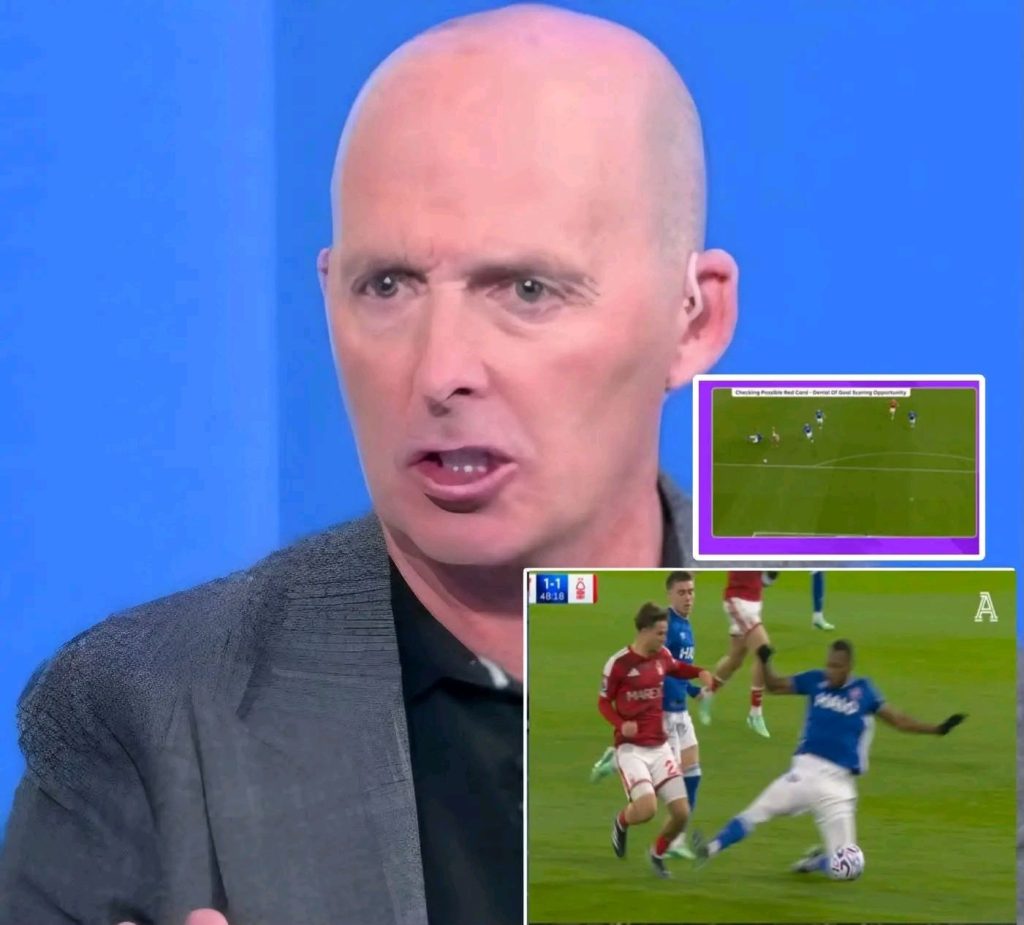
Referee Thomas Bramall’s explanation focused on McAtee’s touch and the direction in which it took the ball.
According to the explanation provided, Bramall believed the movement away from goal meant the incident did not amount to a denial of an obvious goalscoring opportunity.
That reasoning offers an insight into the decision, but it does not automatically end the debate.
The interpretation of an attacking movement is rarely as simple as determining whether the ball travels directly towards goal. An attacker can move laterally or diagonally and still be in an excellent position to score.
Likewise, a player moving directly towards goal may not have an obvious goalscoring opportunity if the ball is beyond their control or defenders are positioned to intervene.
Referees are required to evaluate the full situation rather than apply a single mechanical test.
This is where the controversy becomes particularly significant.
If Bramall considered McAtee’s touch to have removed the realistic possibility of a clear scoring chance, his decision would be based on the assessment that one of the essential requirements for a red card was missing.
If, however, McAtee remained in control and had a clear route towards goal, critics could argue that the decision did not sufficiently account for the attacking circumstances.
Without a complete assessment of the footage, including the precise positioning of the players and the ball, it would be premature to declare that the referee unquestionably made an error.
Nevertheless, the explanation has provided plenty of material for debate among supporters who believe the challenge deserved a more severe punishment.
What do the laws of football actually say?
The laws governing the denial of an obvious goalscoring opportunity are designed to distinguish between an ordinary foul and an offence that illegally prevents a player from having a clear chance to score.
A red card can be issued when a player denies an opponent an obvious goalscoring opportunity through an offence punishable by a free kick or penalty, subject to the specific provisions of the laws.
Four major considerations guide the assessment.
First, the distance to goal. The closer an attacker is to goal, the more likely the situation may represent an obvious scoring opportunity, although distance alone is not decisive.
Second, the direction of play. Referees examine whether the attacker is moving towards goal or whether the movement suggests the opportunity is developing away from a scoring position.
Third, the likelihood of controlling the ball. An attacker who has a realistic chance of retaining or gaining possession is more likely to be considered to have had an obvious opportunity than a player chasing a ball they are unlikely to reach.
Fourth, the position and number of defenders. If another defender is well placed to challenge the attacker or cover the route to goal, the opportunity may not be considered obvious.
These factors must be assessed together.
Consequently, Bramall’s reference to McAtee’s touch is relevant, but it is not necessarily conclusive on its own. The direction of the touch must be understood in the context of the other factors.
This is precisely why decisions of this nature often generate such intense disagreement.
Two incidents can appear similar to supporters watching from the stands but lead to different outcomes because the attackers’ control, the defenders’ positions or the available route to goal differs.
That does not mean every decision is correct. It means that any serious assessment must examine the full sequence rather than rely exclusively on the final image of the challenge.
Was this a case of Nottingham Forest being robbed?
The word ‘robbed’ is likely to feature prominently in the reaction from frustrated supporters, particularly if they believe the decision denied Forest a significant advantage.
However, a controversial refereeing decision and deliberate wrongdoing are not the same thing.
There is no established evidence from the information available here that officials intentionally favoured Ipswich or deliberately acted against Nottingham Forest.
The more defensible criticism is that the decision may have been incorrect or that the explanation has not adequately addressed the circumstances that made the challenge controversial.
That distinction matters.
Football supporters have every right to question decisions that appear inconsistent with the laws of the game. They can demand explanations, compare similar incidents and challenge the standards of officiating without assuming that a referee deliberately set out to disadvantage their club.
If the footage demonstrates that McAtee was in control of the ball, had a realistic route towards goal and was denied an obvious scoring opportunity by Diop’s foul, the argument for a red card becomes considerably stronger.
If the evidence instead shows that the attacker had moved away from a realistic scoring opportunity or was unlikely to retain possession, the yellow card may be defensible.
The available explanation has not removed the uncertainty surrounding the incident.
For Forest supporters, that uncertainty is part of the frustration. They want to understand precisely why the referee believed the challenge fell short of the red-card threshold.
PGMOL faces another test of consistency
The controversy also raises a broader question about the communication of refereeing decisions.
Supporters regularly hear that officials must consider several factors when deciding whether an attacker has been denied an obvious goalscoring opportunity. Yet when a disputed challenge occurs, the explanation can sometimes appear to focus on one element of the incident.
That can leave fans wondering whether the same standards are being applied consistently across different matches.
PGMOL, which oversees professional match officials in England, faces continuing pressure to explain major decisions clearly and help supporters understand the reasoning behind them.
The aim should not be to guarantee that every supporter agrees with a referee. That would be impossible in a sport where decisions often involve subjective judgment.
Instead, explanations should identify the relevant considerations, clarify how they were applied and address the key point of disagreement.
In this case, that means explaining why McAtee’s touch was considered sufficient to undermine the claim that he had an obvious goalscoring opportunity.
Was the ball moving too far away from him? Was another defender positioned to intervene? Was McAtee’s angle towards goal significantly reduced? Or did the referee believe the attacker was unlikely to retain possession?
Those questions are more useful than a general statement that the ball was moving away from goal.
Clear communication would not necessarily end the argument, but it could help supporters understand the decision and judge whether the laws had been applied correctly.
Why the decision matters for Nottingham Forest
For Nottingham Forest, incidents like this can have an emotional impact because supporters naturally focus on the moments they believe could have changed a match.
A potential red card is particularly significant because it can alter the balance of a contest. If a team is reduced to ten players, the consequences can extend well beyond the immediate incident, affecting tactical decisions, substitutions and the ability to defend against sustained pressure.
However, the precise impact of the Diop decision on the final result should not be exaggerated without considering the wider match.
A disputed booking does not automatically establish that Forest were denied victory, nor does it prove that the referee’s decision determined the outcome.
What it does create is a legitimate point of discussion about whether the correct disciplinary action was taken.
For a club seeking consistency from match officials, that question deserves a clear answer.
Forest supporters will understandably want to know whether the incident was assessed against the same criteria that have led to red cards in comparable situations.
They may also question whether the explanation would have been the same had the identities of the teams been reversed.
Those questions reflect a wider concern across football: supporters want decisions to be judged according to the laws rather than the circumstances surrounding a particular club.
The only reliable way to address that concern is through transparent reasoning and consistent application of the rules.
The final verdict: yellow card or red card?
The controversy at Portman Road ultimately comes down to a difficult but important question: did Issa Diop’s challenge deny James McAtee an obvious goalscoring opportunity?
Bramall’s explanation suggests that he believed McAtee’s touch took the ball away from goal to such an extent that the incident did not satisfy the requirements for a red card.
That is the official reasoning described for the decision.
But the direction of the touch cannot be treated as the only consideration. The attacker’s control, distance from goal, direction of play and the positions of other defenders all matter when determining whether a scoring opportunity was obvious.
If those factors supported the conclusion that McAtee had a clear route towards goal, the case for a red card would be strong. If they suggested that the opportunity was no longer clear, the yellow card could be justified.
Without a complete, independently assessed view of the incident, it would be irresponsible to claim that the decision was unquestionably wrong.
Nevertheless, the question being asked by Forest supporters remains valid: if McAtee appeared to be through on goal, what specifically prevented the challenge from meeting the criteria for a red card?
That is the issue PGMOL’s explanation needs to address.
The debate is not simply about whether one team received a favourable decision. It is about whether the laws of the game were applied correctly and whether supporters have been given enough information to understand the reasoning.
For now, Diop’s yellow card remains a controversial talking point, Bramall’s explanation has not eliminated the disagreement, and the argument over what constitutes an obvious goalscoring opportunity continues.
Was Thomas Bramall right to show Issa Diop a yellow card, or should the Ipswich defender have been sent off for his challenge on James McAtee?

 admin


