 admin
admin
FIFA Reveals Why Scotland Were Not Awarded a Penalty Against Morocco Despite John McGinn Incident
Scotland’s narrow 1-0 defeat to Morocco has sparked a fierce debate among supporters, pundits and former referees after a controversial incident involving captain John McGinn inside the penalty area. As Scotland pushed desperately for an equaliser in the closing stages, many fans believed McGinn had been fouled by a Moroccan defender and should have been awarded a penalty that could have changed the outcome of the match.
The incident quickly became one of the most talked-about moments of the game, with social media flooded by screenshots and slow-motion clips showing apparent contact on the Scottish midfielder. Many supporters were left asking the same question: why was a penalty not given?
According to FIFA’s interpretation of the incident, the answer lies in the nature of the contact, the positioning of both players and the referee’s judgment that the challenge did not meet the threshold required for a penalty kick.
The Moment That Sparked Outrage
The controversial incident occurred late in the match with Scotland trailing 1-0. McGinn was attempting to shield the ball inside the Moroccan penalty area when a defender challenged him from behind.
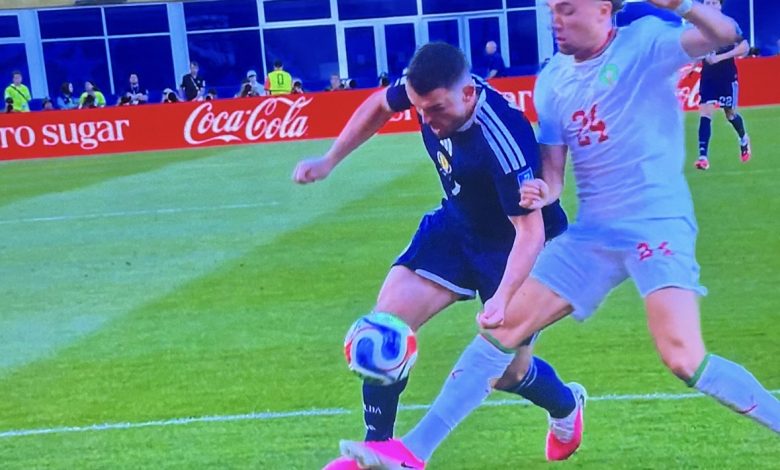
From certain camera angles, it appeared that contact was made with McGinn’s foot and lower leg while he was attempting to maintain possession. The Scottish captain immediately appealed for a penalty, while several teammates also raised their arms in protest.
However, the referee waved play on.
What surprised many supporters even more was the fact that VAR did not recommend an on-field review. Given the significance of the moment and the apparent contact shown on television replays, fans expected the incident to receive closer scrutiny.
Instead, the match continued, leaving Scotland frustrated and Morocco able to hold onto their slender advantage.
Why FIFA Believes No Penalty Should Have Been Awarded
Under the Laws of the Game, not every instance of contact inside the penalty area automatically results in a penalty.
Referees are instructed to determine whether the challenge was careless, reckless or involved excessive force. They must also judge whether the contact directly prevented the attacking player from playing the ball.
FIFA’s interpretation appears to be that the defender was making a legitimate attempt to challenge for possession and that the level of contact was insufficient to constitute a foul.
Officials reportedly viewed the incident as normal physical contact that occurs frequently during high-level football matches, especially when a player is shielding the ball with his body.
The key factor was not whether contact occurred, but whether that contact was illegal under the laws governing fouls and misconduct.
Many supporters focus on the fact that McGinn’s foot appeared to be clipped or stepped on. However, referees are instructed to assess the entire action rather than a single freeze-frame image.
A still image can sometimes make an incident appear more serious than it actually was when viewed in real time.
According to FIFA’s refereeing guidelines, decisions should be based on the full sequence of play rather than isolated moments captured in photographs.
The Role of VAR
One of the biggest talking points after the match was VAR’s decision not to intervene.
Many supporters assume VAR exists to correct every controversial decision, but the system operates under a much narrower remit.
VAR can only recommend intervention when a “clear and obvious error” has occurred.
If the video officials believe that the referee’s original decision falls within a reasonable interpretation of the laws, they will not intervene, even if some viewers disagree with the call.
This appears to be exactly what happened in Scotland’s match against Morocco.
Video officials reviewed the incident and determined that there was not enough evidence to conclude that the referee had made a clear and obvious mistake.
As a result, the original decision stood.
While this explanation may not satisfy Scottish supporters, it is consistent with how VAR is designed to operate.
Why Scottish Fans Are Angry
The frustration among Scotland supporters is understandable.
When a team is trailing by a single goal in the final minutes, every major decision becomes magnified.
Many fans felt the images clearly showed contact on McGinn and argued that similar incidents have resulted in penalties elsewhere.
Others pointed out that modern football has seen penalties awarded for considerably less obvious contact.
For supporters watching from the stands or on television, the challenge looked significant enough to warrant at least an on-field review.
The lack of a monitor check only increased the sense of injustice.
Social media platforms quickly filled with comments from fans questioning both the referee’s decision and VAR’s refusal to intervene.
Several former players also suggested that Scotland had every right to feel aggrieved.
The Other Side of the Argument
Not everyone agrees that Scotland were denied a legitimate penalty.
Some refereeing analysts have argued that McGinn was already leaning into the defender while attempting to protect possession of the ball.
Others believe the defender’s actions were part of a normal shoulder-to-shoulder challenge and that the contact seen in replay footage was incidental rather than foul-worthy.
Supporters of this viewpoint argue that football remains a contact sport and that awarding a penalty for every touch inside the box would fundamentally alter the game.
From their perspective, the referee correctly allowed play to continue.
This difference in interpretation highlights one of football’s biggest challenges.
Even with modern technology, many incidents remain subjective.
Two experienced referees can view the same footage and arrive at different conclusions.
How the Decision Affected Scotland
The controversy overshadowed much of Scotland’s performance.
Steve Clarke’s side had battled hard throughout the match and remained in contention despite Morocco taking an early lead.
Scotland enjoyed periods of possession and created several opportunities but struggled to find the breakthrough they desperately needed.
As the clock ticked down, the McGinn incident appeared to offer a lifeline.
Had a penalty been awarded and converted, the match could have taken a completely different direction.
Instead, Scotland were left chasing the game during the closing minutes.
The final whistle confirmed a disappointing defeat and ensured that the refereeing decision would dominate post-match discussion.
McGinn’s Importance to Scotland
The reaction to the incident was intensified by the player involved.
John McGinn has become one of Scotland’s most influential figures over the past decade.
The midfielder is widely regarded as the heartbeat of the national team, providing leadership, energy and creativity.
His ability to drive forward from midfield and inspire teammates has made him a fan favourite.
When McGinn appealed so passionately for a penalty, many supporters interpreted his reaction as evidence that he genuinely believed he had been fouled.
His frustration was evident immediately after the incident and remained visible throughout the remainder of the contest.
Given his importance to the team, it was inevitable that the debate would continue long after the final whistle.
The Fine Margins of Modern Football
The controversy also serves as a reminder of how fine the margins can be at international level.
Matches between strong nations are often decided by a single moment.
A goal, a save, a red card or a penalty decision can determine the outcome.
For Scotland, the difference between defeat and a potential comeback may have come down to one referee’s interpretation of a challenge.
For Morocco, the decision allowed them to preserve their lead and secure an important victory.
Such moments are part of what makes football both thrilling and frustrating.
Supporters invest emotionally in every decision because they understand how much is at stake.
Could the Laws Change in Future?
Incidents like this frequently reignite discussions about VAR and officiating standards.
Some observers believe referees should be encouraged to use pitchside monitors more often.
Others argue that greater transparency is needed so fans can better understand why decisions are made.
There have also been calls for refereeing bodies to release audio conversations between match officials and VAR teams.
Supporters believe this would provide valuable insight into how controversial incidents are assessed.
Whether such reforms are introduced remains to be seen.
For now, football continues to rely on the judgment of officials interpreting complex situations in real time.
Scotland Must Move Forward
While the penalty controversy will undoubtedly remain a major talking point, Scotland must eventually shift their focus to future matches.
Teams that compete at the highest level cannot afford to dwell on individual decisions for too long.
Managers and players often stress the importance of controlling what they can control.
Although the frustration is understandable, Scotland will know that future success depends on maintaining concentration and continuing to improve performances.
The debate surrounding McGinn’s challenge may continue for weeks, but the result itself cannot be changed.
Conclusion
The controversy surrounding John McGinn’s penalty appeal against Morocco has divided opinion across the football world. While many Scotland supporters remain convinced that a spot-kick should have been awarded, FIFA’s interpretation of the incident appears to be that the contact did not constitute a foul under the Laws of the Game.
The crucial point is that referees and VAR officials did not view the challenge as a clear and obvious infringement. As a result, the original decision to play on remained unchanged.
Whether fans agree with that explanation is another matter entirely.
For Scotland supporters, the incident will likely be remembered as the defining moment of a painful defeat. For Morocco, it was simply another defensive action that helped secure a valuable victory.
What is certain is that the debate will continue long after the match itself has faded from memory, with many Scottish fans still convinced that their team was denied a golden opportunity to rescue a result when it mattered most.


 admin
admin