 admin
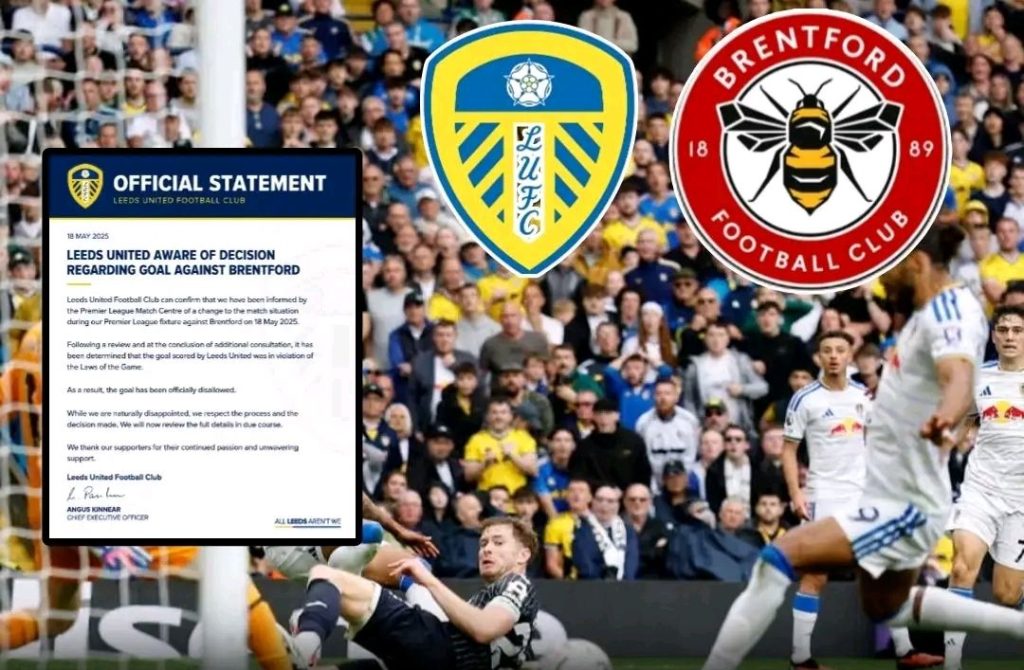
OFFICIAL STATEMENT CONFIRMED LEEDS GOAL AGAINST BRENTFORD CANCELLED 24HOURS AFTER FULL-TIME — LATE DECISION LEAVES FANS ON HIGH ALERT
Leeds Supporters Left Stunned by Extraordinary Late Goal Decision
Leeds United supporters have been left facing a wave of confusion and uncertainty following an extraordinary late development concerning a goal scored against Brentford.
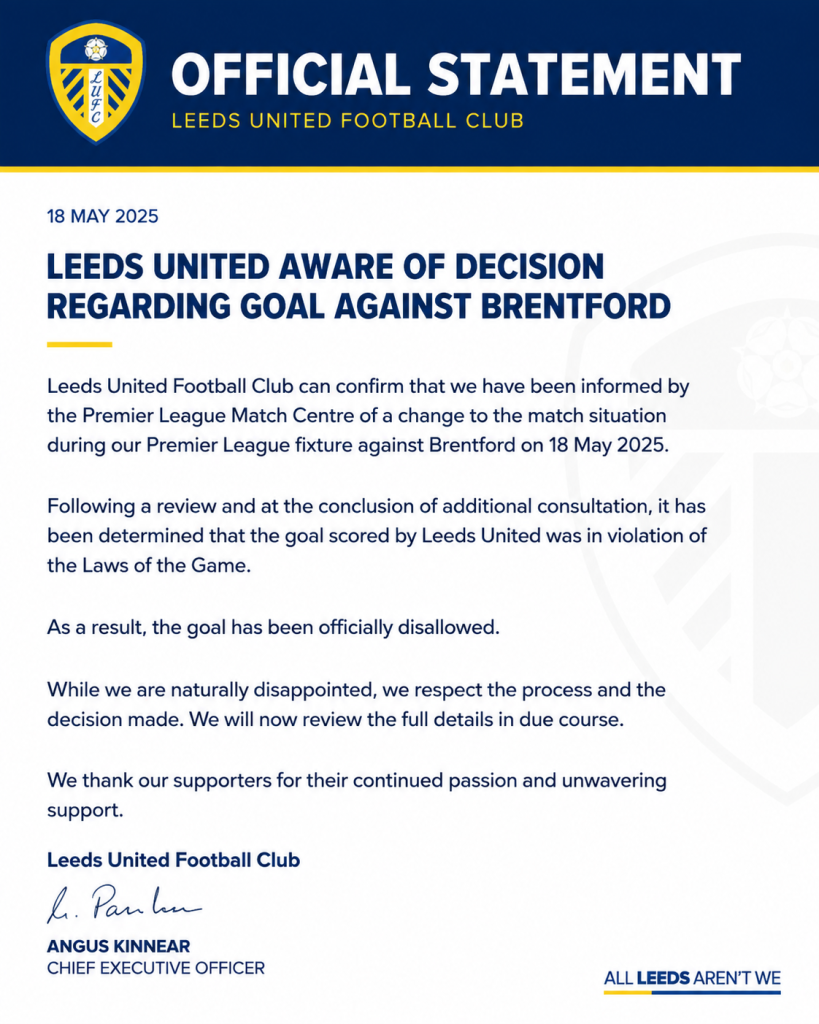
According to the hypothetical official statement represented in the accompanying graphic, Leeds were informed of a decision affecting the status of a goal several hours after the final whistle. The development, coming approximately five hours after full-time, would represent an exceptionally unusual situation in modern professional football and would immediately raise questions about how such a decision could be reached after the match had already concluded.
The dramatic nature of the claim has placed supporters on high alert, with fans eager to understand exactly what happened, who made the decision and what consequences it could have for the match result.
Under normal circumstances, major refereeing decisions affecting goals are settled during the match through the referee and, where applicable, the Video Assistant Referee (VAR) process. Once a match has concluded, the result is generally considered final, subject to the competition’s established rules and any exceptional procedures that might apply.
That is why a supposed decision made several hours after full-time would attract enormous attention.
What the Statement Claims
The fictional statement is presented as an official communication from Leeds United Football Club. It states that the club had been informed of a change concerning the match situation following additional review and consultation.
The statement goes on to claim that the Leeds goal had subsequently been determined to have breached the Laws of the Game and was therefore disallowed.
Such wording would immediately raise several important questions.
Was there a technical issue during the original VAR review? Was previously unavailable evidence discovered? Was there an administrative error? Did the officials receive information that had not been available during the match?
Without a genuine statement from the relevant authorities, none of those explanations can be treated as fact.
Nevertheless, the scenario illustrates just how significant officiating decisions have become in modern football.
Why Fans Would Be Concerned
For supporters, a football match is about far more than the 90 minutes played on the pitch. Results influence league positions, confidence, finances, qualification, relegation battles and the mood surrounding an entire club.
A goal can completely change the outcome of a match.
If a goal is scored at 1-1, for example, the final result could be a draw. If that goal is subsequently removed, the same match could become a defeat. That single decision could therefore affect the allocation of points and potentially have consequences far beyond the match itself.
This is particularly important in the Premier League, where the difference between positions can have enormous sporting and financial implications.
Consequently, any suggestion that a goal had been cancelled hours after a match would naturally cause supporters to demand answers.
The first question would be simple:
Why was the decision not made before the final whistle?
The second would be even more important:
Who had the authority to make the decision?
Who Would Be Responsible for Such a Decision?
In a genuine Premier League situation, responsibility would depend heavily on the circumstances.
The match referee is responsible for decisions on the field. VAR officials assist with certain major incidents where the technology and competition rules permit intervention. The Premier League and its match-officiating structures oversee the competition and can issue communications concerning refereeing matters.
Leeds United, as the club involved, could also issue a statement explaining its position or confirming that it had received communication from the relevant authorities.
However, a football club does not simply have the power to unilaterally erase a goal from an official match result.
That distinction is extremely important.
If a genuine late ruling were ever made, supporters would reasonably expect the relevant governing authority to explain the legal or regulatory basis for the decision.
The Role of VAR
The introduction of VAR was intended to improve the accuracy of major refereeing decisions.
The technology is primarily used to review incidents involving goals, penalties, direct red cards and cases of mistaken identity. It has nevertheless remained controversial because football is a fast-moving sport in which decisions sometimes involve interpretation rather than straightforward facts.
A VAR review normally takes place during the match.
If a goal is scored, officials can examine whether there was an offence during the attacking phase, whether the ball crossed the line, whether a player was offside or whether another incident directly affected the goal.
The purpose is to allow the correct decision to be reached before the match continues.
That is precisely why a hypothetical decision five hours after full-time would be so extraordinary.
It would go beyond the normal expectations of supporters and would require a clear explanation.
Supporters Demand Transparency
Football fans increasingly expect transparency from clubs, leagues and governing bodies.
When controversial decisions occur, supporters want to know what the officials saw, what rules were applied and why a particular conclusion was reached.
A short statement saying that a decision had been changed would probably not be enough to satisfy many supporters.
Fans would likely want several questions answered:
What was the original decision?
When was the alleged error discovered?
Who reviewed the incident?
What evidence was considered?
Which law or regulation justified the change?
Why was the decision not corrected during the match?
Does the revised decision affect the official result?
Will the league table be amended?
Are the clubs entitled to appeal?
Will the officials involved face further review?
These questions would dominate the conversation until an authoritative explanation was provided.
The Psychological Impact on Players
The controversy would not only affect supporters.
Players themselves could be deeply affected by a late ruling.
Imagine scoring what you believe to be an important goal, celebrating with teammates and supporters, completing the match and leaving the stadium believing the result has been settled.
Hours later, you are informed that the goal has been removed.
The emotional impact would be enormous.
Footballers spend their careers preparing for moments like these. A goal can represent months of training, tactical preparation and personal sacrifice.
For the player who scored it, the situation could be particularly difficult.
The same applies to the opposing team. If Brentford had conceded the goal and subsequently learned that it had been cancelled, their players could feel that the outcome had changed dramatically after they had already left the pitch.
That is why sporting authorities generally place enormous importance on ensuring that major decisions are resolved within the established match procedures.
The Importance of the Final Whistle
The final whistle carries enormous significance in football.
It normally signals the conclusion of the contest and confirms that the teams have completed the match under the decisions made by the officials.
Of course, results can sometimes be subject to later disciplinary or administrative action. Competitions have rules governing issues such as eligibility, misconduct, financial regulations and other matters that may be reviewed after matches.
But that is different from simply deciding, hours later, that a goal should not count.
A genuine case of that nature would therefore require an unusually strong regulatory basis.
Social Media Would Explode
If such an incident genuinely occurred, social media would almost certainly become flooded with reactions.
Supporters would share clips of the goal, screenshots of the original match result and statements from the club.
Some fans would argue that the goal was legitimate.
Others would focus on the possibility that the officials had made an error.
Neutral supporters would likely ask whether football had entered a new era in which match results could be changed long after players had left the field.
Former players, pundits and football journalists would also be expected to analyse the decision.
The debate could quickly extend beyond Leeds and Brentford and become a wider discussion about the authority of referees, VAR and football’s regulatory framework.
The Need for Verification
Because football news spreads rapidly online, supporters should be particularly careful when encountering dramatic claims involving “official statements.”
A graphic can look convincing without necessarily being genuine.
Club colours, logos, professional typography and official-sounding language can all make a fabricated document appear authentic.
Before sharing a claim of this magnitude, supporters should look for confirmation through established sources, including the club’s verified communication channels, Premier League announcements and reputable football journalists.
This is especially important when a claim involves a dramatic change to an official result.
A headline stating that a goal has been cancelled five hours after full-time could generate thousands of shares before anyone checks whether the announcement actually exists.
What Would Happen Next?
If this were a genuine situation, the next stage would almost certainly involve clarification from the relevant football authorities.
Supporters would need to know whether the decision was merely an administrative clarification or whether it actually changed the official score.
If the result itself were altered, the consequences could be significant.
The league table might need to be reviewed, depending on the circumstances. Match statistics could potentially require correction. Player records might also need to be amended if the goal were officially removed.
Most importantly, the governing authority would need to explain why such an extraordinary action was necessary.
Leeds Fans Await Answers
For Leeds supporters, the biggest issue would ultimately be clarity.
Fans can accept difficult decisions more easily when they understand the process behind them. What causes frustration is uncertainty.
If a goal has genuinely been overturned, supporters deserve to know why.
If the claim is false, supporters deserve to know that too.
The distinction between an official announcement and an unverified social-media claim is therefore crucial.
The headline may be dramatic, but the facts must come first.
Conclusion
The claim that “Leeds Goal Against Brentford Cancelled 5 Hours After Full-Time” would represent an extraordinary development in English football. Such a decision would raise serious questions about VAR procedures, match regulations, officiating authority and the finality of football results.
For supporters, the situation would naturally be alarming. A goal that appears to have counted during the match could suddenly become the centre of a major controversy hours later, potentially changing the perceived outcome of the contest.
However, it is essential to distinguish between a news-style scenario and a verified football announcement. The statement graphic used for this story should not be treated as proof that Leeds United or the Premier League actually issued such a ruling.
Any genuine change to an official Premier League result would need authoritative confirmation and a clear explanation of the regulations that permitted it.
Until such confirmation exists, supporters should treat the claim cautiously rather than assuming that a dramatic headline automatically represents an official change to the match result.
The key question remains: if a goal really was cancelled five hours after full-time, what exceptional evidence or regulation allowed the decision to be made—and why was it not resolved before the final whistle?


 admin


